Schema Forge
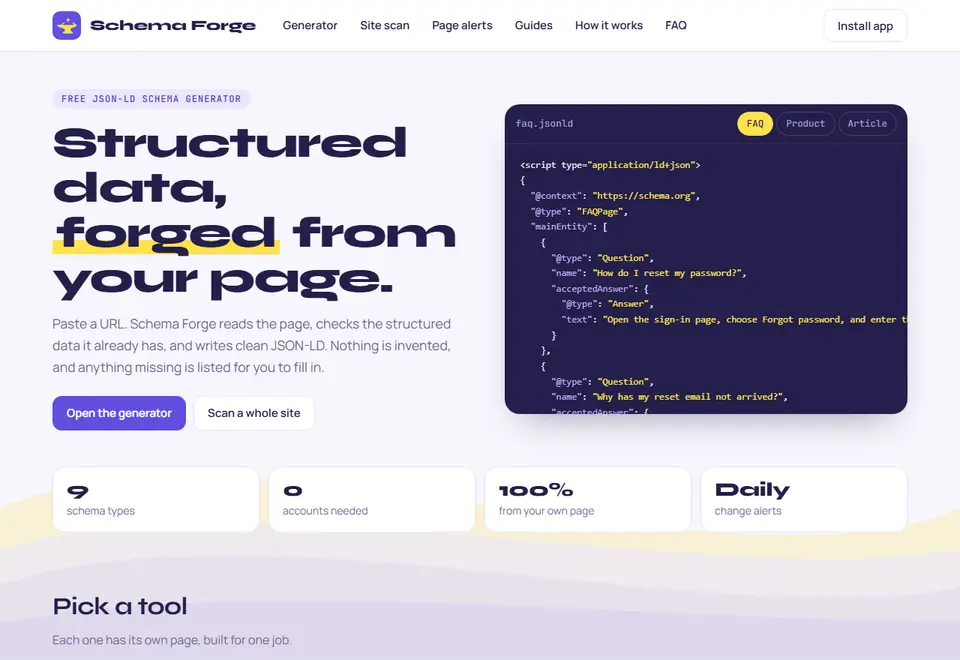
Structured data, forged from your page.
Structured data tells Google and AI tools what a page is: a product, an event, a list of questions. Schema Forge reads a public page, checks the markup it already has, and writes clean JSON-LD. Nothing is invented: anything the page leaves out becomes a field for you to fill in.
- 9schema types
- 100point health score
- 10pages in one site scan
- 5pages watched per browser
Nine types, read from the page
Each type is built from facts the page states. Pick one to see what it reads and the markup it writes.
FAQPage
Read the guideQuestions and answers from headings, details elements and definition lists.
{
  "@context": "https://schema.org",
  "@type": "FAQPage",
  "mainEntity": [
    {
      "@type": "Question",
      "name": "Do you ship internationally?",
      "acceptedAnswer": {
        "@type": "Answer",
        "text": "Yes, to over 40 countries."
      }
    }
  ]
}
Product
Read the guideName, image, price, currency, brand and SKU, from microdata, meta tags and shop themes.
{
  "@context": "https://schema.org",
  "@type": "Product",
  "name": "Stoneware Mug, 350 ml",
  "sku": "MUG-350-GRN",
  "brand": {
    "@type": "Brand",
    "name": "Hearthstead"
  },
  "offers": {
    "@type": "Offer",
    "price": "24.00",
    "priceCurrency": "USD"
  }
}
LocalBusiness
Read the guideName, phone, address and opening hours, with the right subtype such as Plumber.
{
  "@context": "https://schema.org",
  "@type": "Plumber",
  "name": "Marlow & Finch Plumbing",
  "telephone": "+1-555-0100",
  "address": {
    "@type": "PostalAddress",
    "addressLocality": "Springfield",
    "addressRegion": "IL"
  }
}
Article
Read the guideHeadline, author and dates. Pages under /blog/ become BlogPosting.
{
  "@context": "https://schema.org",
  "@type": "BlogPosting",
  "headline": "How to reset your Hearthstead password",
  "author": {
    "@type": "Person",
    "name": "Priya Nandakumar"
  },
  "datePublished": "2026-03-14T09:30:00Z"
}
Organization
Read the guideSite name, logo, phone, email and social profiles, best on the home page.
{
  "@context": "https://schema.org",
  "@type": "Organization",
  "name": "Hearthstead",
  "url": "https://example.com/",
  "logo": "https://example.com/img/logo-512.png"
}
BreadcrumbList
Read the guideThe trail of links above the page title, each step with its position.
{
  "@context": "https://schema.org",
  "@type": "BreadcrumbList",
  "itemListElement": [
    {
      "@type": "ListItem",
      "position": 1,
      "name": "Home",
      "item": "https://example.com/"
    },
    {
      "@type": "ListItem",
      "position": 2,
      "name": "Mugs"
    }
  ]
}
Event
Read the guideName, dates with time zones, venue and tickets. A missing venue is flagged, not guessed.
{
  "@context": "https://schema.org",
  "@type": "Event",
  "name": "Spring Glazing Workshop",
  "startDate": "2026-04-18T10:00:00-05:00",
  "location": {
    "@type": "Place",
    "name": "Hearthstead Studio"
  }
}
Recipe
Read the guideIngredients, steps, times and yield from recipe cards.
{
  "@context": "https://schema.org",
  "@type": "Recipe",
  "name": "Brown Butter Oat Cookies",
  "recipeYield": "24 cookies",
  "prepTime": "PT15M",
  "cookTime": "PT12M"
}
VideoObject
Read the guideVideo elements and YouTube or Vimeo embeds: name, thumbnail, date and length.
{
  "@context": "https://schema.org",
  "@type": "VideoObject",
  "name": "How to glaze a mug in five minutes",
  "uploadDate": "2026-05-02T08:00:00Z",
  "duration": "PT5M12S"
}
Every gap becomes a field
This product page states no price and no brand. Schema Forge leaves them out and asks. Fill them in and the markup updates as you type, the way it does in the app.
{
  "@context": "https://schema.org",
  "@type": "Product",
  "name": "Stoneware Mug, 350 ml",
  "sku": "MUG-350-GRN"
}78of 100
A score you can read
Every page gets a health score from 0 to 100, and the reasons behind it, so the number is never a mystery. 60 percent is coverage, 40 percent is the quality of the markup already there.
- 2 of 3 types that fit this page are marked up.
- Could add: Organization.
- 1 recommended property is missing from it.
A sample page, scored with the app's own formula: 67 percent coverage, 95 percent quality.
Four tools and an API
/generatorGeneratorPaste a URL or the page’s HTML. Get JSON-LD for nine types, with existing markup checked and where to paste it in HTML, WordPress, Shopify, Webflow and Next.js./scanSite scanReads a sitemap and scores up to 10 pages: which have schema, which have errors, which could use more. Export a CSV, or a zip of ready markup./alertsPage alertsWatch up to 5 pages and get a browser notification when their structured data is added, removed, broken or fixed. No account./llms-generatorllms.txt builderBuilds an llms.txt file for a site from its sitemap: a title and one line for each main page./docs/apiAPIJSON endpoints with open CORS: check, analyze, scan, badge and llms, for your own audit tools.
What it cannot do yet
- Pages built only with JavaScript cannot be read here. Paste the page’s HTML instead; it is flagged when a page looks JavaScript-built.
- FAQ accordions made of plain div elements are not detected. Headings, details elements and definition lists are.
- Site scans and the llms.txt builder stop at 10 pages, and stop early if a site is slow, to stay inside the host’s time limit.

Try it on your own page
Paste the address of any public page. Schema Forge opens with your page loaded. It takes a few seconds and needs no sign-up.
Use Schema Forge with
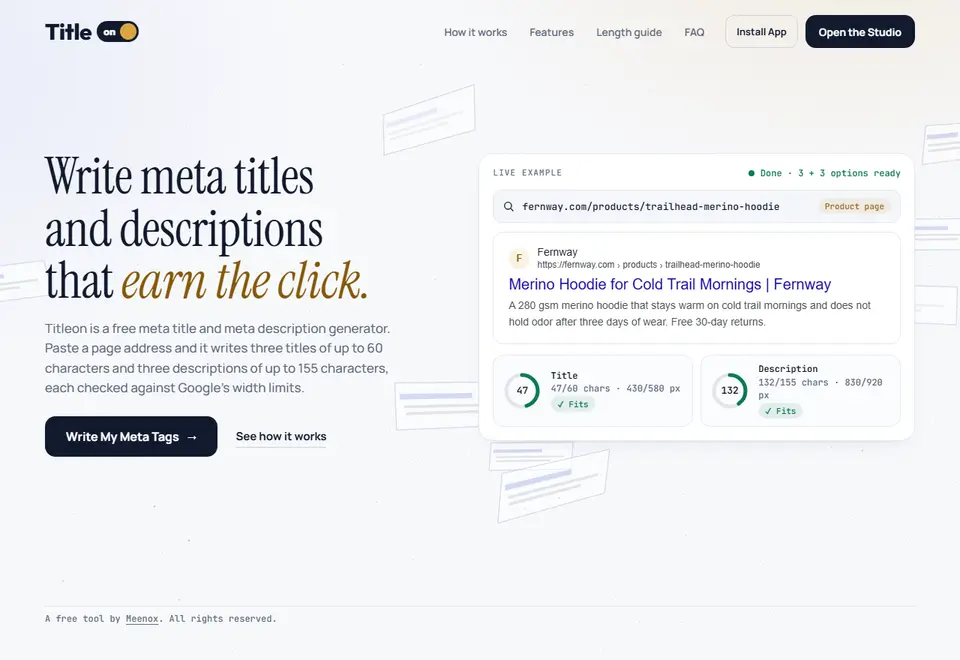
 Titleon
 Silkpath
Schema Forge, as it looks today
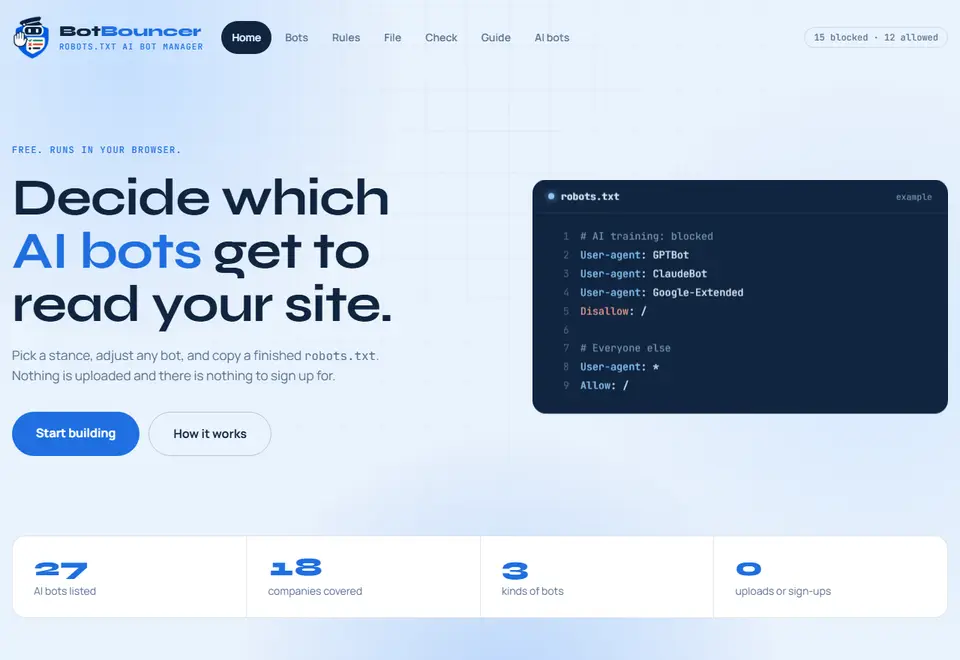
 Bot Bouncer
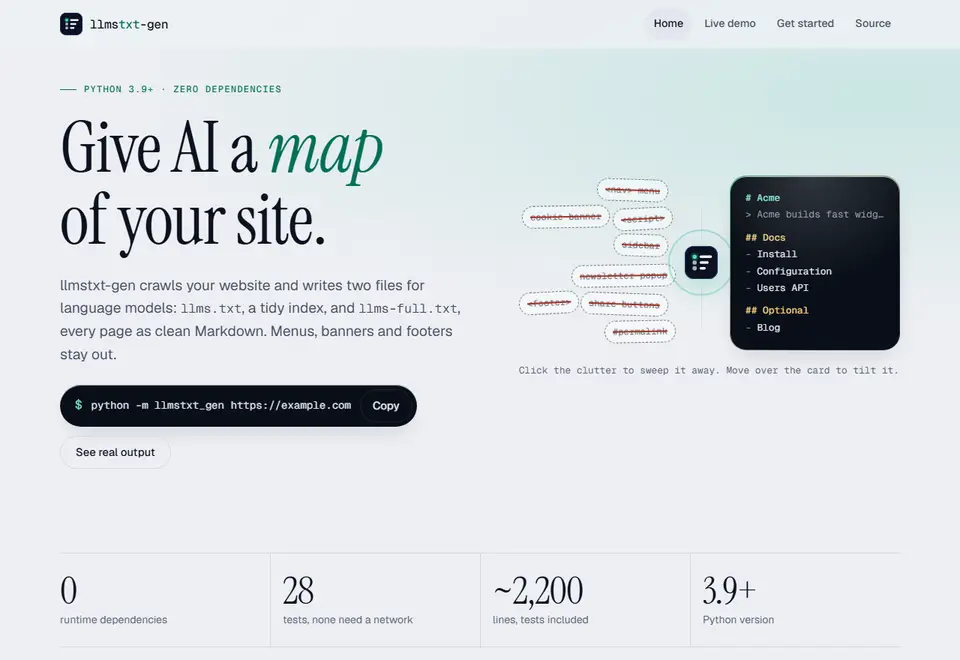
 llmstxt-gen